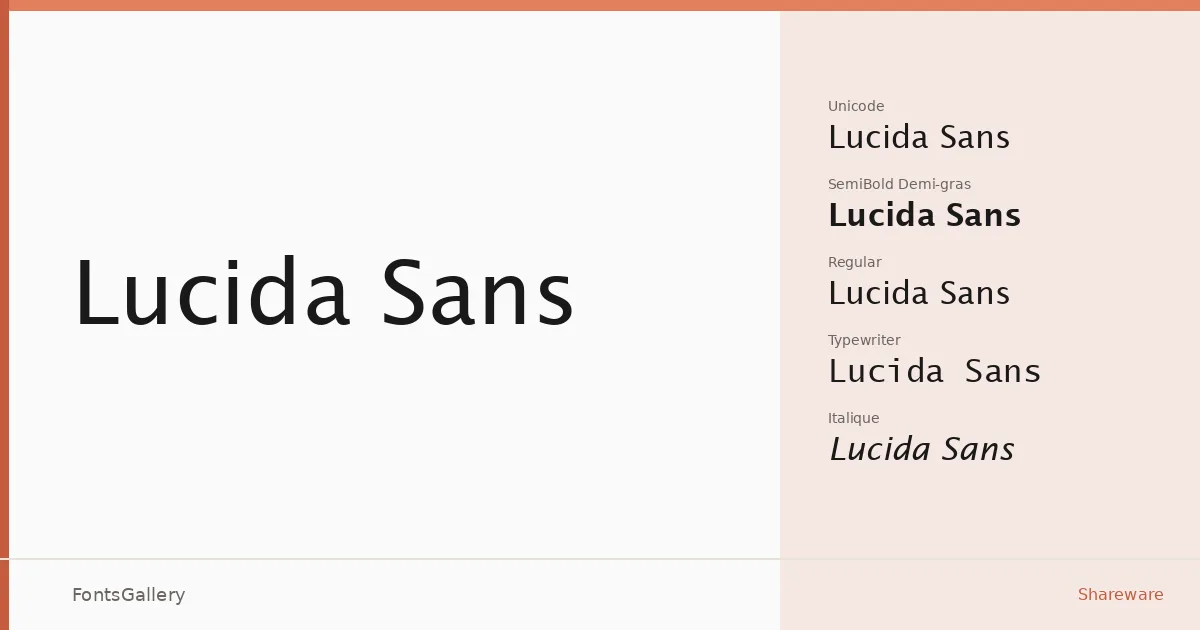
About Lucida Sans Font
There is a steadiness to this face that becomes obvious the moment you set a paragraph: the large x-height keeps every line open and legible even at modest sizes, and nothing in the letterforms competes with the words themselves. It carries a copyright from Bigelow & Holmes Inc., dating to 1993, and that mid-century clarity of intention is still visible in every glyph. The strokes are clean without being cold, and the proportions sit comfortably across a wide range of contexts.
Design Aesthetics & Character Characteristics
This is a classic, professional sans serif with a modern, minimal sensibility — the kind of face that earns its place in directories, tables, forms, and manuals precisely because it never draws attention to itself. The family ships as TTF files and spans nine styles: a Regular Normal and Regular Italique, SemiBold Demi-gras and SemiBold Demi-gras Italique, a Regular Unicode for broader character access, and a full Typewriter branch — Regular Typewriter, Regular Oblique, SemiBold Typewriter Gras, and SemiBold Gras Oblique — that gives you a monospaced companion within the same family. One practical note on spacing: at 14 points or larger, pulling back a few units of letter spacing tightens the color nicely, while all-caps settings benefit from a touch of extra room between letters.
Recommended Usage & Font Pairing
The breadth of script coverage — Latin, Latin Extended (partial), Cyrillic, Greek, and Hebrew — makes it a serious candidate for business cards, presentations, signage, posters, and magazine layouts that need to travel across writing systems. For pairings, the listed companions are Canela, Allura, 321 Impact, ABC Arizona, and Ballmain, which between them cover editorial contrast, script warmth, and high-impact display work. At the glyph level, the ampersands and special characters in Lucida Icons are designed to combine directly with this face.
License & Usage Terms
This font is distributed under a Shareware license as a Microsoft-supplied font; commercial use is not permitted, so confirm your intended application against the full Microsoft license terms before taking it into a client job. Embedding is permitted at the editable level, and temporary downloading to a printer or output device for printing purposes is allowed, but all other uses beyond those expressly covered by your Microsoft product's terms are prohibited.