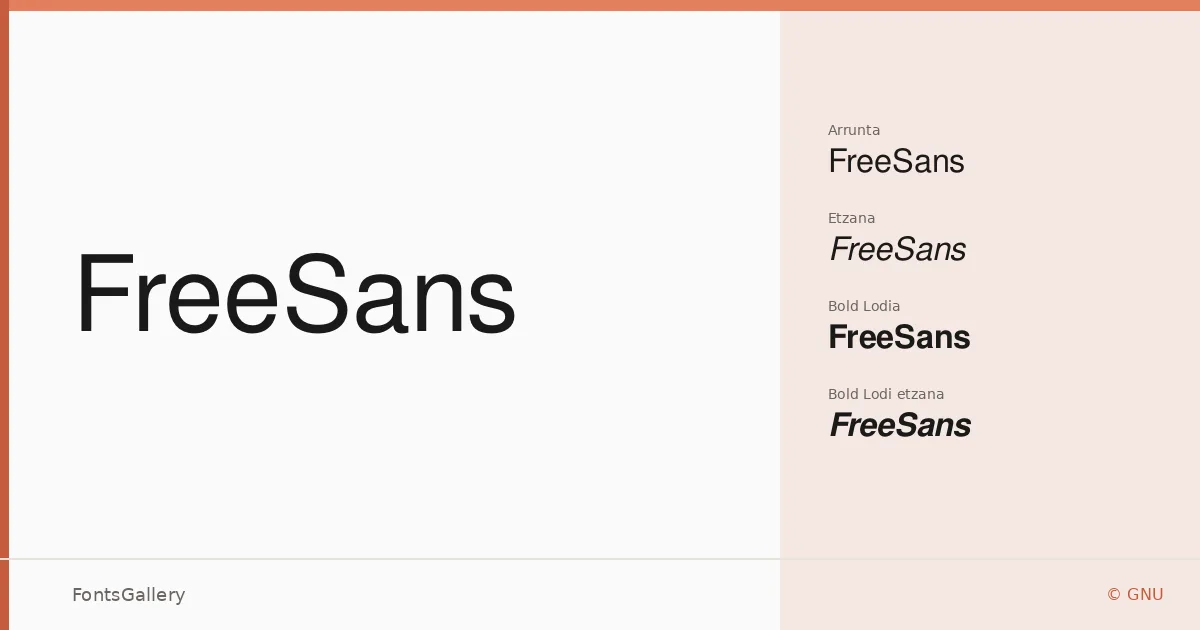
About FreeSans Font
There is a quiet confidence to this sans-serif from GNU — clean strokes, open apertures, and a neutrality that doesn't tip into coldness. What sets it apart from the crowd of geometric grotesques is its script coverage: the family ships as OTF files carrying Latin, Cyrillic, Greek, Armenian, Hebrew, Syriac, Devanagari, Bengali, Gurmukhi, Gujarati, Georgian, Cherokee, Canadian Aboriginal Syllabics, Tifinagh, Vai, and partial Latin Extended and Vietnamese support — a breadth that reflects its origins as free software infrastructure rather than a single-market retail release.
Design Aesthetics & Character Characteristics
The family sits squarely in the modern, minimal end of sans-serif design, with a professional composure that reads crisply at both display and text sizes. Four styles are available — Regular, Regular Etzana, Bold Lodi etzana, and Bold Lodia — giving you a functional regular-to-bold pairing across the weight range. The letterforms are even-tempered and rational: consistent stroke widths, restrained contrast, and a geometry that keeps headlines tidy and body copy readable without demanding attention for itself.
Recommended Usage & Font Pairing
Its minimal, professional character makes it a natural fit for branding systems, magazine layouts, presentation decks, signage, and website headers — anywhere legibility and neutrality need to hold across multiple languages simultaneously. For contrast, the listed pairing families are Aranea, Ballmain, 321 Impact, Aresink, and Batoshi, each offering a distinct counterpoint to its even geometry.
License & Usage Terms
FreeSans is released under the GNU General Public License (version 3 or later) and is listed here under personal-use terms — confirm licensing requirements before deploying it in a commercial job, and review the full GPL at gnu.org/copyleft/gpl.html. One practical note: embedding the font unaltered into a document does not cause that document to fall under the GPL, and the embedding permission is set to installable.