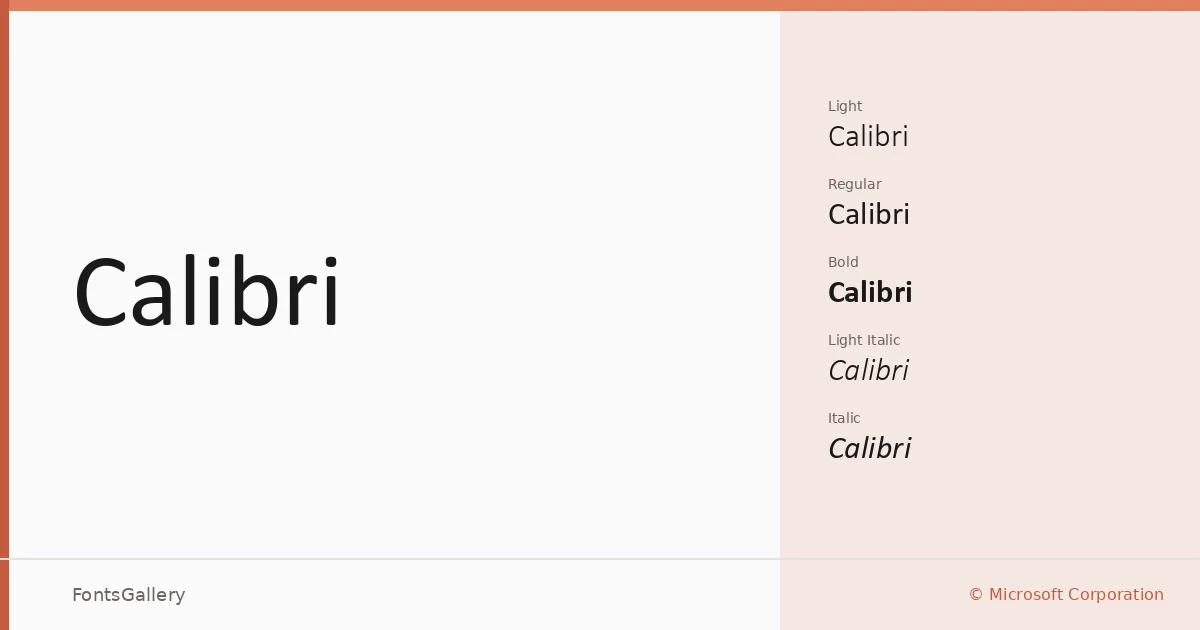
About Calibri Font
There is a particular warmth to this face that you do not always expect from a sans serif — subtle roundings on stems and corners that soften what might otherwise be a strictly neutral construction. Designed by Luc(as) de Groot and published by Microsoft Corporation, it delivers real italics, small caps, and multiple numeral sets rather than relying on mechanical slanting or faked variants. At larger sizes those curves become especially evident, giving the letterforms a soft, approachable quality that holds up equally well in tight, small text.
Design Aesthetics & Character Characteristics
The family sits in the sans serif category and carries a mood that is at once classic, minimal, and professional without feeling cold. Six styles are available — Calibri Light, Calibri Light Italic, the Regular, Regular Italic, Bold, and Bold Italic — covering a range of weight and emphasis that works across both delicate and authoritative settings. The proportions are generous enough that lines set tightly still breathe, and the modern structure means the family reads cleanly whether you are pushing it large or keeping it small. Files are delivered in TTF format.
Recommended Usage & Font Pairing
The design suits branding work, business cards, magazine layouts, presentation decks, and website headers — contexts where a professional but human-feeling sans is more effective than something purely geometric or mechanical. Language coverage is broad: Latin, Latin Extended, Vietnamese, Cyrillic, Greek, Armenian, Hebrew, Arabic, Georgian, Lisu, and partial Coptic support, making it a practical choice for multilingual editorial and corporate work. For pairing, it sits well alongside Canela, Armelie, 321 Impact, AQUA, and Kactigona, each offering a contrasting texture or personality that the neutral warmth of this face can anchor.
License & Usage Terms
This is a Microsoft-supplied font offered under Personal Use terms — commercial use is not permitted, so confirm compliance with the full Microsoft license before deploying it in a commercial job. Embedding is permitted at the editable level; any use beyond creating, displaying, and printing content within the bounds of the originating Microsoft product or service is prohibited under the stated terms.