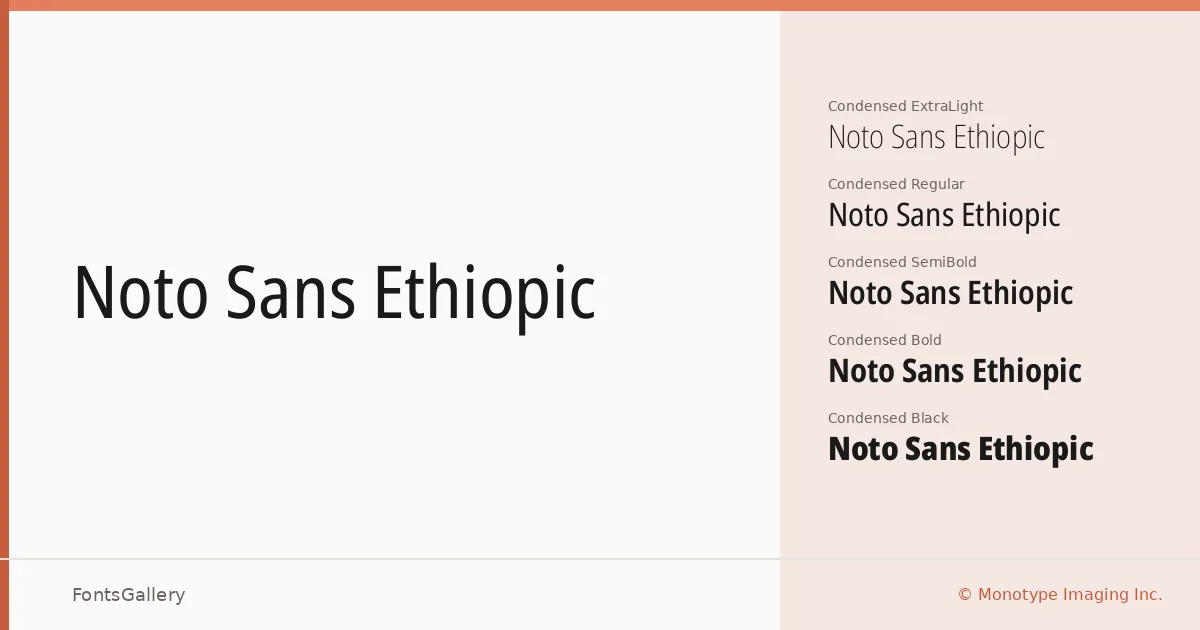
About Noto Sans Ethiopic Font
What strikes you first about this family is the sheer breadth of what it covers: clean, unmodulated strokes drawn to serve both the Latin alphabet and the Ethiopic script within a single coherent system. It was produced by the Monotype Design Team as part of the broader Noto project, a long-running effort to eliminate typographic blind spots across the world's writing systems. The Ethiopic glyphs share the same measured, open geometry as the Latin counterparts — nothing feels grafted on or retrofitted.
Design Aesthetics & Character Characteristics
This is a sans-serif family with a minimal, modern, and professional disposition — the kind of neutrality that holds up across demanding editorial and branding contexts without calling attention to itself. The weight range runs from Thin through Black, and each weight is available across four width variants: ExtraCondensed, Condensed, SemiCondensed, and the default upright, plus a Variable file that lets you move freely across that entire weight axis in a single TTF. That combination of discrete static styles and a variable format gives layout work unusual flexibility without requiring a switch between files.
Recommended Usage & Font Pairing
The compressed widths and heavier weights are well suited to signage and website headers where type needs to command space efficiently, while the lighter cuts feel at home in magazine body text and presentation decks where a professional, unfussy tone matters. The dual-script Latin and Ethiopic coverage makes this particularly valuable for publishers, NGOs, and digital platforms working with Amharic or Tigrinya alongside English. For contrast in a layout, the listed pairing candidates — Canela, Angeletta, Rasley Heights, Dharma Gothic E, and Times New Roman — each offer a different kind of counterpoint, from warm serif to high-contrast display.
License & Usage Terms
This family is released under the SIL Open Font License (OFL), Version 1.1, which explicitly permits commercial use; full terms and the accompanying FAQ are available at https://scripts.sil.org/OFL. Embedding is set to installable, so the fonts can be distributed inside documents without restriction.