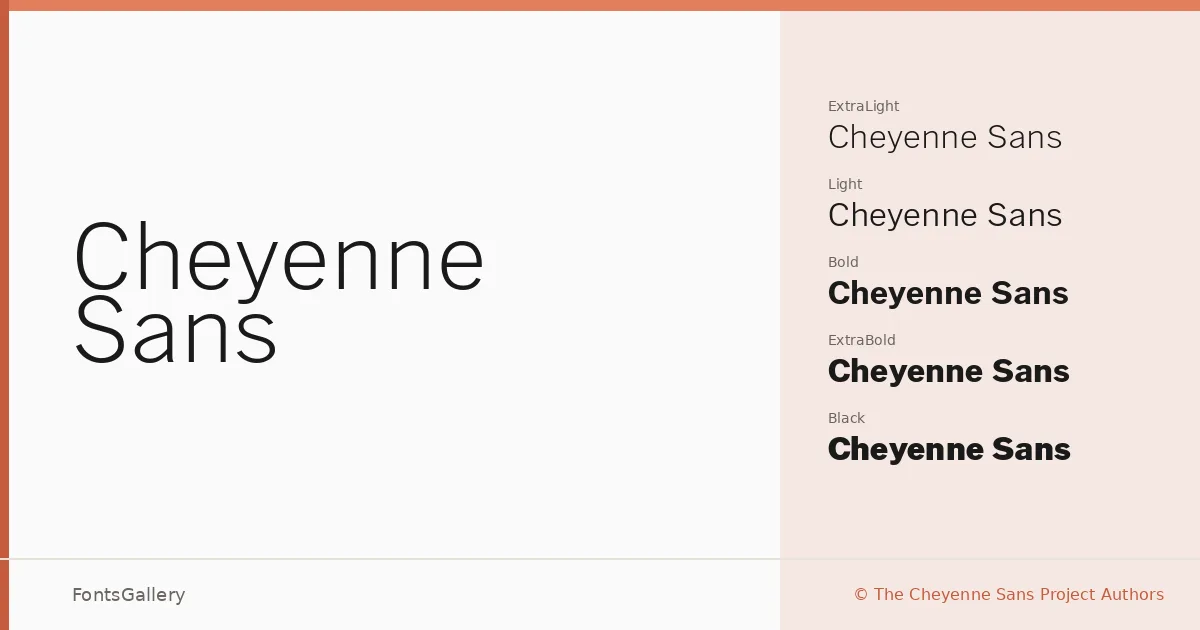
About Cheyenne Sans Font
What strikes you first is the clarity — the kind of open, unhurried neutrality that comes from a family built on serious foundations. Cheyenne Sans emerges from a lineage that includes Public Sans (from the U.S. Web Design System authors), Libre Franklin by Pablo Impallari and Rodrigo Fuenzalida, Roboto Flex by David Berlow, and General Gothic by Barry Mieny, with principal changes made by Cristiano Sobral under The Cheyenne Sans Project Authors. The result is a sans-serif whose letterforms sit upright with quiet confidence — even spacing, restrained contrast, and terminals that feel resolved rather than decorative.
Design Aesthetics & Character Characteristics
The family spans Thin through Black, each weight paired with a true italic, and the set also includes Variable and Variable Italic cuts for fluid weight control — all available in both TTF and OTF formats. The mood throughout is minimal and modern without tipping into cold or clinical territory; the proportions are professional and the stroke widths graduate naturally across the range, so Light headlines and Bold labels feel like they belong to the same considered system. Greek, Cyrillic, Vietnamese, and Latin Extended coverage (partial) give the family real reach for multilingual work.
Recommended Usage & Font Pairing
The weight range and clean architecture make this well-suited to website headers, editorial magazine layouts, business card typography, presentations, and branding work where legibility and a modern, professional register are the brief. For contrast in mixed-type settings, the family has been paired with the high-contrast serif Canela, the script Armelie, the display faces 321 Impact and AQUA, and the geometric Kactigona — combinations that let the sans hold structure while the companion face carries warmth or drama.
License & Usage Terms
Released under the SIL Open Font License (OFL), Version 1.1, commercial use is permitted, and the fonts may be embedded with installable permissions; the full license text and FAQ are available at scripts.sil.org/OFL, with an additional license covering USWDS modifications at the Public Sans GitHub repository.